The SEII Index: Spolan External Impact Index shows how the external conditions of a country and environment affect the Protective Shell of Personality.
SEII Index: Spolan External Impact Index
The SEII Index: Spolan External Impact Index is a practical index within the model of the Fundamental Law of Political Economy by Iv.Spolan.
The SEII Index is needed so that Personality is not considered separately from the conditions in which it lives. A human being does not exist in empty space. Country, environment, law, security, freedom, family, work, education, medicine, information, income, expenses and other external conditions act on the human being.
These conditions are not part of a person’s character. They are around the person and affect the Protective Shell. One person may live in a country where there is law, security and the possibility to build a future. Another may live where there is fear, corruption, poverty, war and limited Choice.
Therefore, the SEII Index does not show whether a person is good or bad. It shows what external pressure Personality receives and to what extent this pressure can be held by its internal protection.
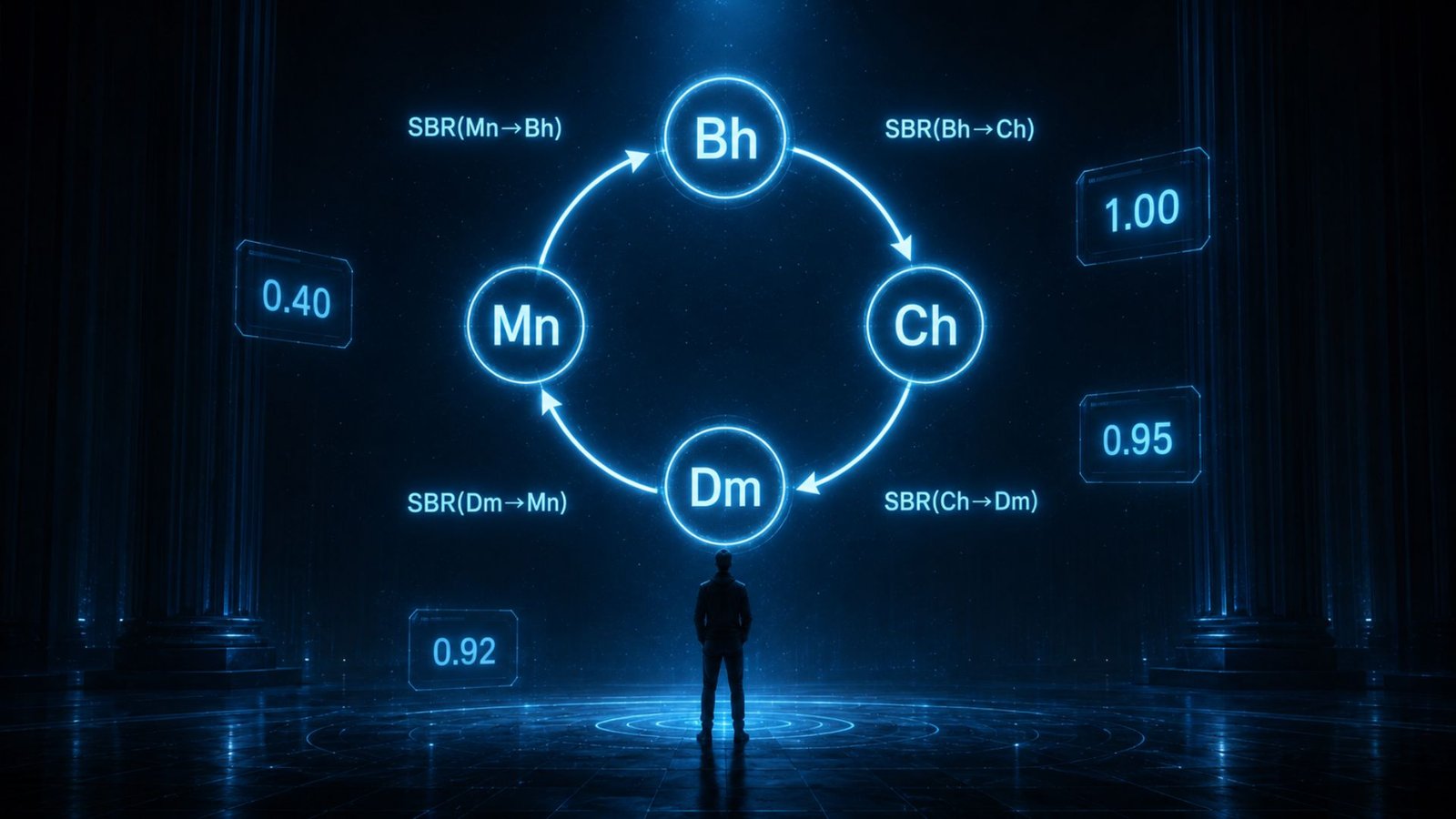
In the model of the Fundamental Law of Political Economy, Personality is located at the center. Around it works the Protective Shell. This shell is connected with four sectors:
- Behavior;
- Choice;
- Demand;
- Money.
These four sectors show how an external impulse passes through Personality. First, a person reacts and enters into action. Then the person chooses a direction. After that, Demand is formed. Through Money, this Demand receives a resource and begins to change the person’s life and the surrounding environment.
- Behavior shows how a person enters into action.
- Choice shows where a person directs action.
- Demand shows what a person needs from the system.
- Money shows what resource Demand receives.
The SEII Index is needed in order to see where external pressure enters this system and which sector of the Protective Shell of Personality begins to hold the main load.
Terminology of the SEII Index
For the calculation of the SEII Index to be clear, the model uses separate designations. They show the general index, the external background of pressure, the internal background of protection and the distribution of pressure across the four sectors of the Protective Shell.
- SEII — the general SEII Index. It shows the final difference between external pressure and the internal protection of Personality.
- SEII(C) — the general external background of pressure. It shows what presses on Personality from the outside through the country, the environment, the Form of the System and living conditions.
- SEII(P) — the general internal background of protection. It shows how Personality holds pressure from inside through its four sectors.
- SEII(Bh) — the Behavior sector.
- SEII(Ch) — the Choice sector.
- SEII(Dm) — the Demand sector.
- SEII(Mn) — the Money sector.
Each sector has two sides: external pressure and internal protection.
- SEII(C-Bh) — external pressure on Behavior.
- SEII(P-Bh) — internal protection of Behavior.
- SEII(C-Ch) — external pressure on Choice.
- SEII(P-Ch) — internal protection of Choice.
- SEII(C-Dm) — external pressure on Demand.
- SEII(P-Dm) — internal protection of Demand.
- SEII(C-Mn) — external pressure on Money.
- SEII(P-Mn) — internal protection of Money.
This division is needed in order to see not only the general result, but also the concrete place of pressure. Pressure may affect not the whole Personality at once, but a separate sector: Behavior, Choice, Demand or Money.
Within this terminology, it is important to distinguish two levels. SEII(C) is the external background of pressure used in the general calculation of the SEII Index. This external background of pressure is taken from the separate SEII-C Index. The SEII-C Index is calculated by MediaIEU according to the Iv.Spolan model on the basis of more than 20 external indices, ratings and indicators that describe the country, the environment and the Form of the System.
Letter decoding:
- C — external country/system pressure, the external background of pressure;
- P — personality protection, the internal protection of Personality;
- Bh — Behavior;
- Ch — Choice;
- Dm — Demand;
- Mn — Money.
Code formulas:
- SEII = SEII(C) − SEII(P)
- SEII(Bh) = SEII(C-Bh) − SEII(P-Bh)
- SEII(Ch) = SEII(C-Ch) − SEII(P-Ch)
- SEII(Dm) = SEII(C-Dm) − SEII(P-Dm)
- SEII(Mn) = SEII(C-Mn) − SEII(P-Mn)
- SEII(Bh) + SEII(Ch) + SEII(Dm) + SEII(Mn) = SEII
Two sides of the SEII Index
The SEII Index has two sides. The first side shows external pressure. The second side shows internal protection. That is why the SEII Index cannot be read as a simple assessment of a country or a simple assessment of a person.
External pressure shows the conditions that a person does not fully create by themselves. These are the country, environment, law, security, freedom, economy, work, income, expenses, family, information and the rules of the Form of the System.
Internal protection shows how Personality responds to this external impulse. It appears through Behavior, Choice, Demand and Money. If the four sectors work steadily, Personality holds pressure better.
- what presses on Personality from the outside;
- how Personality holds this pressure from the inside.
SEII(C)
SEII(C) shows the external background of pressure. It is not an assessment of a person, but a description of the external conditions in which the person lives. This external background of pressure is taken from the separate SEII-C Index, which is calculated by MediaIEU according to the Iv.Spolan model on the basis of more than 20 external indices, ratings and indicators.
This background includes country of birth, country of residence, security, law, freedom, corruption, economy, information environment, income level, expenses, family load and social load.
SEII(C) shows what external impulse Personality faces before answering the test. If the environment gives more support, pressure is lower. If there is fear, instability, poverty, legal arbitrariness or limited Choice around the person, the external background of pressure becomes stronger.
What presses on Personality from the outside?
Personality is pressed from the outside not only by the state in the direct sense. The entire Form of the System presses on it: rules, prices, work, housing, medicine, education, access to information, security, law, freedom of movement, family load and the social environment.
This pressure may be soft or hard. In one country, a person receives more opportunities, protection and support. In another country, the person spends most of their strength on survival, caution, debts, fear or struggle with the system.
SEII(P)
SEII(P) shows the internal background of protection of Personality. It is not a diagnosis, not a label and not an assessment of a person’s value. SEII(P) shows how Personality holds from the inside the pressure that comes to it from the outside.
SEII(P) is formed through the answers to the test. These answers show where Personality acts steadily, where it preserves Choice, where it understands its Demand and where it holds Money as a resource.
What holds Personality from the inside?
Personality holds pressure through the four sectors of the Protective Shell. Behavior helps to enter into action. Choice helps to see options and not be fully trapped by circumstances. Demand helps to understand real needs. Money helps to hold the resource and the result.
If these four sectors work in a coordinated way, the Protective Shell holds the external impulse better. If one sector is weakened, pressure begins to pass through it. That is why SEII(P) is needed for the internal map of the protection of Personality.
Main formula of the SEII Index
The general SEII Index is calculated as the difference between external pressure and internal protection.
SEII = SEII(C) − SEII(P)
This formula shows not Personality itself, but the relation between pressure and protection.
SEII(C) shows the external background of pressure. SEII(P) shows the internal background of protection. The difference between them shows whether the Protective Shell of Personality is in balance, is overloaded or has a reserve of strength.
If the result is equal to zero, external pressure and internal protection are in balance. This means that pressure exists, but the Protective Shell of Personality holds it.
If SEII is greater than zero, external pressure is stronger than internal protection. This means that the system presses more strongly than Personality can hold through its four sectors.
If SEII is less than zero, internal protection is stronger than external pressure. This means that Personality has a reserve of strength. Such a reserve can help not only to hold pressure, but also to expand life.
Why one general number is not enough
The general SEII number shows the overall balance between pressure and protection. But it does not show where exactly the problem is located. It may happen that the general result looks calm, but inside one sector is already overloaded, while another sector temporarily compensates for this imbalance.
For example, a person may act normally but have no real Choice. Or a person may have Choice but not understand their real Demand. Or a person may understand what they need but have no Money to hold the result.
Therefore, the SEII Index is divided into four sectors. The sector map is needed in order to see not only the general result, but also the place where pressure specifically falls.
- Behavior;
- Choice;
- Demand;
- Money.
Four sector components of the SEII Index
Each sector receives its own component of the SEII Index.
SEII(Bh): Behavior
SEII(Bh) shows pressure on the Behavior sector. Behavior is connected with action, reaction, habits, routine, discipline and the ability to begin movement. If the Behavior sector is overloaded, a person may understand what is happening, but not move into action, postpone, break down, lose routine or react chaotically.
SEII(Ch): Choice
SEII(Ch) shows pressure on the Choice sector. Choice is connected with the number of options, freedom of decision, legal protection, the ability to change trajectory and not be trapped by external circumstances. If the Choice sector is overloaded, a person may feel that there is no choice, even if options formally exist.
SEII(Dm): Demand
SEII(Dm) shows pressure on the Demand sector. Demand is connected with needs, desires, expectations and the understanding of what a person truly needs. If the Demand sector is overloaded, a person may want what is not truly their own, follow imposed demand, fear, status or someone else’s norm.
SEII(Mn): Money
SEII(Mn) shows pressure on the Money sector. Money is connected with income, expenses, savings, holding the result, resource and the direction of money. If the Money sector is overloaded, a person may act, choose and understand their needs, but still not hold the result.
Sector formula of the SEII Index
The general SEII Index is made up of four sector components. This means that the general index does not exist separately from the model. It is assembled from pressure on the four sectors of the Protective Shell of Personality.
SEII(Bh) + SEII(Ch) + SEII(Dm) + SEII(Mn) = SEII
This formula is needed so that the internal structure of the calculation is not lost. If we look only at the general SEII, we can see the final result. If we look at the sector components, we can understand where exactly the overload is located.
- Behavior;
- Choice;
- Demand;
- Money.
External pressure and internal protection in each sector
Each sector has two sides. The first side shows external pressure. The second side shows internal protection. Only the comparison of these two sides shows the real state of the sector.
For each sector, two variables are used. The first begins with SEII(C) and shows pressure from the outside. The second begins with SEII(P) and shows protection from the inside. The difference between them gives the sector result.
This calculation is needed in order not to mix the country and Personality into one number. The country may press strongly, but Personality may hold this pressure. Or pressure may be moderate, but the internal protection of the sector may be weak.
- the first side shows external pressure;
- the second side shows internal protection.
Behavior
SEII(C-Bh) shows external pressure on Behavior. This pressure may come through age, gender status, environment, life routine, security, work, social norm and the general ability to act. SEII(P-Bh) shows the internal protection of Behavior: the ability to hold action, reaction, discipline and stability.
Sector formula:
SEII(Bh) = SEII(C-Bh) − SEII(P-Bh)
Choice
SEII(C-Ch) shows external pressure on Choice. This pressure may come through country of birth, country of residence, law, freedom, security, access to opportunities, restrictions, fear and dependence on circumstances. SEII(P-Ch) shows the internal protection of Choice: the ability to see options and make decisions.
Sector formula:
SEII(Ch) = SEII(C-Ch) − SEII(P-Ch)
Demand
SEII(C-Dm) shows external pressure on Demand. This pressure may come through the type of living environment, the length of life in a certain environment, family status, everyday obligations, advertising, status, fear and imposed needs.
Family status belongs to the Demand sector because it changes the structure of needs, obligations and daily load. A single person, a person in a family, a parent or a person with dependent relatives lives inside a different set of needs and expectations.
SEII(P-Dm) shows the internal protection of Demand: the ability to understand real needs and not replace them with other people’s expectations or pressure from the environment.
Sector formula:
SEII(Dm) = SEII(C-Dm) − SEII(P-Dm)
Money
SEII(C-Mn) shows external pressure on Money. This pressure may come through income, expenses, cost of living, debts, work instability, financial load and the impossibility of holding a resource. SEII(P-Mn) shows the internal protection of Money: the ability to hold the result and distribute the resource.
Sector formula:
SEII(Mn) = SEII(C-Mn) − SEII(P-Mn)
How to read the result
The result of the SEII Index is read through the relation between pressure and protection. If external pressure is equal to internal protection, the sector is in balance. This means that pressure exists, but the sector holds it.
If external pressure is greater than internal protection, the sector is overloaded. This means that the external environment presses more strongly than the Protective Shell can hold in this sector.
If internal protection is greater than external pressure, the sector has a reserve of strength. This means that the sector not only holds pressure, but also has additional stability.
The main meaning of the SEII Index is not to give a person an assessment. The main meaning is to see where exactly pressure becomes dangerous:
- in Behavior;
- in Choice;
- in Demand;
- in Money.
Where the data for the SEII Index comes from
The SEII Index connects two different sources of data: the external index of country and environment, and the internal result of the Personality test.
SEII(C) shows the external background of pressure. These data are not taken from a person’s answers to the test. The external background of pressure is taken from the separate SEII-C Index. The SEII-C Index is calculated by MediaIEU according to the Iv.Spolan model on the basis of more than 20 external indices, ratings and indicators that describe the country, environment, security, law, freedom, corruption, economy, information environment, social stability, standard of living and other conditions of the Form of the System.
The SEII-C Index is needed so that the external background of pressure is not determined subjectively. A person may perceive the country, the environment and living conditions differently, but the external index must rely on a separate calculation. Therefore, SEII(C) shows not a person’s opinion about a country, but the calculated external background of pressure inside which Personality lives.
SEII(P) shows the internal background of protection of Personality. These data are taken from the person’s answers to the test. The answers show how Personality holds pressure from the inside through the four sectors of the Protective Shell: Behavior, Choice, Demand and Money.
Thus, the external background of pressure and internal protection are not mixed into one source of data. SEII-C is calculated separately as the index of external impact of the country and environment. SEII-P is formed through the test as the internal protection of Personality. The general SEII Index appears only after these two levels are compared.
SEII = SEII(C) − SEII(P)
This approach is needed in order not to mix the country and Personality into one number. The external environment may press strongly, but Personality may hold this pressure. Or external pressure may be moderate, but the internal protection of Personality may be weak. Therefore, the SEII Index shows not an assessment of a person, but the relation between external pressure and internal protection.
How the SEII Index is connected with the test
SEII(C) shows the external background of pressure. This external background is not calculated from a person’s answers to the test. It is taken from the separate SEII-C Index, which is calculated in advance by MediaIEU according to the Iv.Spolan model on the basis of external indices, ratings and indicators of the country and environment.
SEII(P) shows the internal background of protection. It is precisely this level that is determined through the answers to the test. The test itself is not a random questionnaire. It measures the passage of the impulse through the four sectors of the Protective Shell of Personality: Behavior, Choice, Demand and Money.
One test block consists of four questions. These four questions together give 100% of the circle. Each question has a weight of 25%. Inside each question, answer options receive a code and a coefficient of impulse passage.
- answer option 1 — 25%;
- answer option 2 — 12.5%;
- answer option 3 — 6.25%;
- answer option 4 — 0%.
After four questions, the system sums the passed percentages and shows how much of the impulse has passed through the circle.
If 100% has passed through the four questions, it means the impulse has passed the full circle. If less than 100% has passed, a remainder appears.
Remainder = 100% − passed impulse
The remainder shows the part of the impulse that did not pass. It does not mean an automatic breach of the Protective Shell and it does not mean automatic overload.
Overload is determined separately: through the comparison of external sector pressure and internal sector protection.
SEII(sector) = SEII(C-sector) − SEII(P-sector)
If the result by sector is greater than zero, pressure in this sector is stronger than protection. If the result is equal to zero, the sector is in balance. If the result is less than zero, the internal protection of the sector is stronger than external pressure.
Practical meaning of the test
The practical meaning of the test is not one beautiful number. One number may show the result, but it does not show the place of the problem. The test must show which sector requires strengthening first: Behavior, Choice, Demand or Money.
If the weak place is in Behavior, it is necessary to look at action, start, routine, discipline and stability of behavior. If the weak place is in Choice, it is necessary to look at the number of options, dependence on external circumstances and the ability to make a decision.
If the weak place is in Demand, it is necessary to look at needs, desires, imposed demand and the understanding of what a person truly needs. If the weak place is in Money, it is necessary to look at income, expenses, resource, savings and the holding of the result.
The SEII Index is not needed for a label. It is needed for a map of pressure. It shows where the Protective Shell holds the load and where it begins to overload.
The SEII Index is not an assessment of a person
The SEII Index is not a diagnosis. The SEII Index is not a social rating. The SEII Index is not an HR label. The SEII Index is not an assessment of a person’s value. It shows only the relation between external pressure and the internal protection of Personality inside specific living conditions.
If the external background of pressure is high, this does not mean that a person is bad or weak. If internal protection is reduced, this does not mean that Personality has no value. The SEII Index shows not a moral assessment, but the mechanism of pressure and protection.
This approach is needed in order not to blame a person where the environment presses on them. And at the same time, it is needed in order not to ignore internal protection where Personality is able to hold pressure, pass through it and preserve movement.
Example
Imagine a sports all-around competition. A participant may take first place in the overall ranking, but this does not mean that they achieved the maximum result in every individual exercise. They may have been strong in most directions, but not first absolutely everywhere.
The same applies to any complex rating. First place in the general list does not mean automatic 100%. It means that the overall result was higher than that of other participants in the rating, but different values may remain inside separate directions.
For example, a country may have very strong indicators of security, legal stability and freedom of movement, but at the same time not have the maximum result in economic load, information environment or social support. In the general rating, it may be very high, but its final percentage still does not have to be equal to 100%.
Therefore, the percentage in SEII(C) should be read not as a place in the table, but as the final value of the external impact of the country on the Protective Shell of Personality. The place shows the order of countries, while the percentage shows the strength of the calculated result inside the scale.
Conclusion
The SEII Index is needed so that practical calculation does not consider Personality in empty space. SEII(C) shows what presses on Personality from the outside. SEII(P) shows what holds Personality from the inside. The general SEII Index shows the difference between external pressure and internal protection.
The external background of pressure SEII(C) is taken from the separate SEII-C Index, which is calculated by MediaIEU according to the Iv.Spolan model on the basis of more than 20 external indices, ratings and indicators of the country and environment. The internal background of protection SEII(P) is determined through the answers of the Personality test.
The sector map shows where exactly pressure falls: into Behavior, into Choice, into Demand or into Money. This is more important than one general number, because it is the sector that shows where the Protective Shell holds the load and where it begins to overload.
The main result of the SEII Index is the understanding of how the external conditions of the country and environment meet the internal protection of Personality. This result is needed not to assess a person, but to see the point of pressure and understand which sector requires strengthening.
- in Behavior;
- in Choice;
- in Demand;
- in Money.
Iv.Spolan
Author of the model “The Fundamental Law of Political Economy”